


 The Spiritual and Artisan Lineage
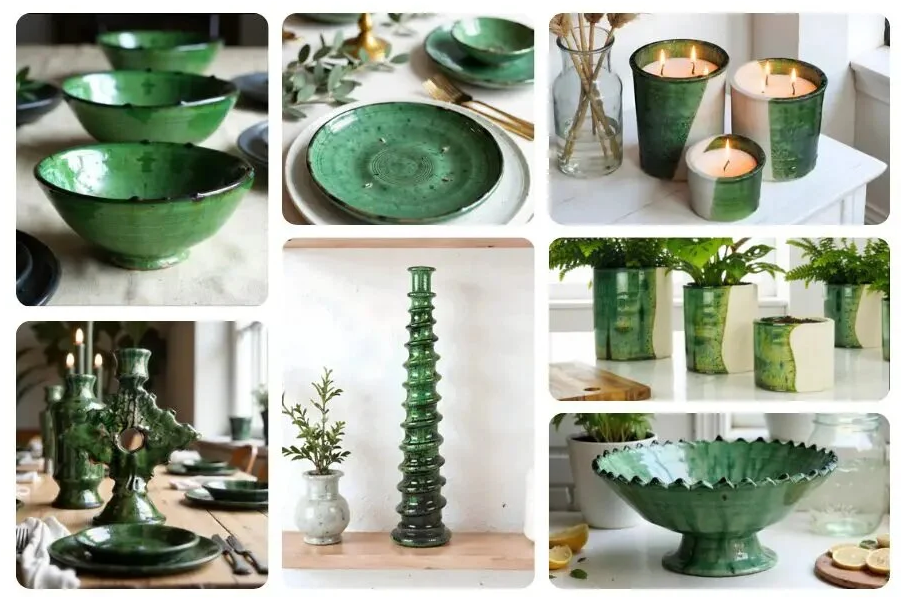
The craft of pottery making in the small village of Tamegroute, located just south of Zagora, is deeply intertwined with the history of the Nasiriyya Sufi brotherhood established in the 17th century. To support the growing religious center, craftsmen were brought from Fes to teach local families utility arts. Over the centuries, these artisans adapted their techniques to the harsh desert environment, developing a distinct pottery style found nowhere else on earth.
Sourcing Raw Desert Materials
The production process begins with the painstaking collection of raw river clay gathered directly from the deep banks of the nearby Draa River. Local apprentices transport the heavy mud back to communal workshops, where it is trodden by foot in deep pits to achieve a smooth, uniform consistency. This specific clay contains a high concentration of local mineral impurities, which react uniquely during the intense heat of the firing process.
The Science Behind the Green Glaze
The signature emerald-green glaze that defines Tamegroute pottery is created using a precise, secret recipe passed down within a few local families. The mixture relies on specific proportions of locally mined manganese, copper oxide, silica, and a unique mineral powder known as kohl. When fired, this chemical combination vitrifies into a striking green finish, with variations in shade depending on where the piece sat inside the traditional kiln.
The Traditional Production Steps
- Clay Kneading: Manual processing of river mud to eliminate air pockets and guarantee a strong structure.
- Hand Throwing: Shaping the vessels on primitive, ground-level foot wheels inside cool, sunken mud workshops.
- Glaze Application: Dipping the sun-dried raw clay directly into the thick, dark mineral glaze mixture.
- Wood Firing: Baking the pottery in subterranean stone ovens fueled by palm fronds and tamarisk wood at high temperatures.
How to Spot Authentic Tamegroute Craft
Because these items are fired in traditional, wood-burning stone kilns without modern temperature controls, every finished piece carries distinct irregularities. Authentic Tamegroute pottery will show small chips where the pieces were stacked using clay trivets, variations in glaze thickness, and a rugged, textured surface. Buyers should value these imperfections as proof of manual craftsmanship, avoiding uniform factory copies made with industrial chemical glazes.