


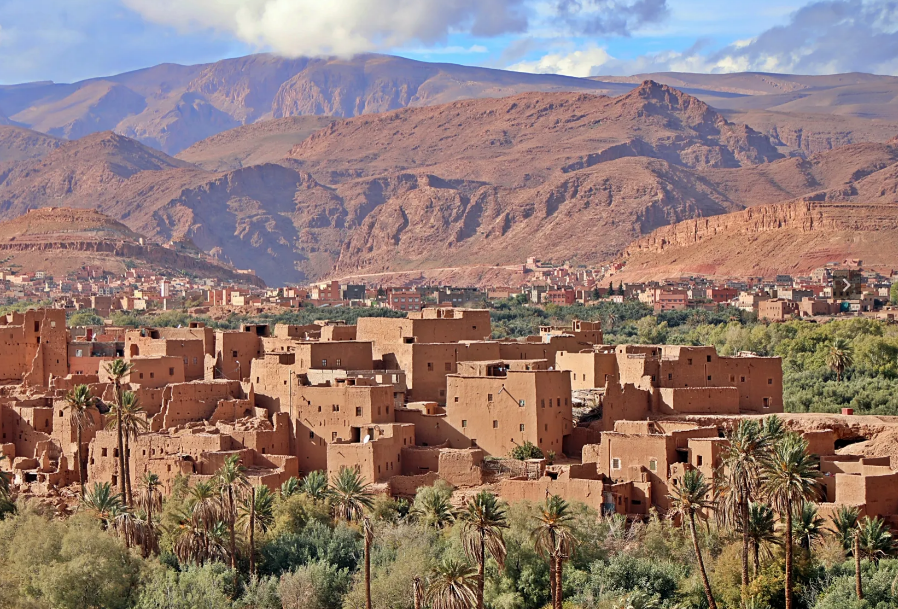
 When you travel through the Todgha Valley and the surrounding landscape of Tinghir, the horizon is dominated by towering, fortress-like structures that seem to grow directly out of the rocky earth. These are the ancient Kasbahs and Ksour (fortified villages) of the Amazigh people.
To the modern traveler, these massive ocre-colored buildings look like romantic monuments from a bygone era. But underneath their rugged, artistic exteriors lies a brilliant, centuries-old masterclass in bioclimatic architecture.
Long before modern engineers calculated thermal insulation, the builders of the Todgha region designed homes perfectly adapted to a harsh desert climate defined by blistering summer heat, cold winter nights, and 0% humidity. Here is how these earth structures achieve natural comfort without a single watt of electricity.
1. Rammed Earth: The Perfect Thermal Sponge
The primary secret of the Kasbah’s thermal comfort is the material itself: pisé (rammed earth) and raw mud bricks mixed with straw.
In a desert environment, temperature fluctuations between day and night are extreme. Earth walls possess a high “thermal mass,” meaning they act like a thermal sponge. During the scorching afternoon, the thick clay walls absorb the external heat very slowly, keeping the interior rooms cool.
By the time the heat finally penetrates the thickness of the wall, the sun has set, and the desert air turns cold. The wall then begins to release that stored warmth into the house during the chilly night. It is a completely natural, continuous cycle of air conditioning and heating.
2. Smart Urban Planning: Living in the Shadows
A traditional Kasbah is not built as an isolated structure; it is part of a dense community fabric designed to fight the sun.
If you walk into an old Ksar near Tinghir, you will notice that the streets are extremely narrow, and many pathways are completely covered by upper-story rooms. This is a deliberate design choice. By packing buildings tightly together and covering walkways, architects ensured that the ground, the outer walls, and the pedestrians are shielded from direct sunlight throughout most of the day.
The narrow alleys also act as natural cooling wind tunnels, channeling the gentle breeze coming from the Todgha River and distributing it through the dense settlement.
3. High Windows and Secret Courtyards
Look closely at the facade of a traditional Kasbah, and you will see a strange design pattern: the ground floor has virtually no windows, while the highest floors feature small, beautifully decorated openings.
This layout serves two essential purposes:
- Protection and Security: The solid, windowless lower walls keep the home safe from stray animals, dust storms, and historical desert conflicts.
- Ventilation: Inside the home, rooms are arranged around a central open-air courtyard (patio). Small windows at the top floors allow hot air to escape naturally as it rises, while drawing cooler, shaded air from the courtyard down into the living spaces. This creates a constant, gentle vertical airflow that keeps the interior fresh.
The Future of Living in Arid Lands
As modern concrete buildings spread across southern cities, they bring a heavy penalty: they trap heat, require constant electric air conditioning, and fail to respect the aesthetic beauty of the landscape.
Today, eco-conscious architects and local developers are looking backward to move forward. By blending ancient rammed earth techniques with modern bioclimatic design (such as optimizing orientations to block dust storms and maximizing solar angles), a new generation of desert villas is proving that sustainable, mud-based architecture is not a relic of the past—it is the smartest option for the future of travel and living in the desert.
Traveler’s Tip: How to Experience a Living Kasbah
Sleeping inside a concrete hotel room will give you a standard experience, but booking a stay in a restored, traditional earth Kasbah completely changes your journey. You will immediately feel the heavy, silent, and naturally cool atmosphere that only clay walls can provide. When exploring Tinghir, take the time to visit the old mud quarters with a local guide who can show you the intricate layout of these ancient bioclimatic fortresses before they disappear.
Fascinated by sustainable architecture and desert design? Discover beautifully restored earth guesthouses and architectural heritage tours in Tinghir on MeldanGo.