


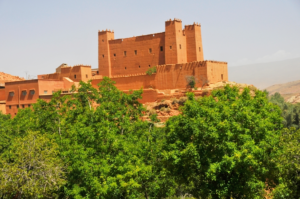
 The Todgha Valley, situated at the confluence of the High and Middle Atlas Mountains, is far more than its iconic limestone gorges. It is the cradle of a complex oasis civilization, structured around thirty ksour (fortified villages). These earthen citadels, standing as testaments to a millennial adaptation to a semi-arid environment, serve as the foundational pillars of Tinghir’s territorial identity.
Rammed-Earth Architecture: Sustainable Engineering
The longevity of the ksour rests on an exceptional mastery of raw-earth construction. Contrary to common misconceptions, this architecture addresses precise bioclimatic imperatives:
Thermal Inertia: Rammed-earth walls, typically ranging from 50 to 80 cm in thickness, maintain a constant indoor temperature, providing essential cooling during summer months when temperatures frequently exceed 40°C.
Composition: A composite of clay, straw, and local gravel, compressed within wooden formwork, grants these structures remarkable durability against aeolian erosion.
Spatial Organization: The ksar is designed as a compact defensive unit, utilizing narrow alleys to create constant shade, which minimizes ground moisture evaporation.
Structured Social Organization
Historically, the ksar is not merely a collection of dwellings; it represents a rigorous political and social framework. The management of water—a scarce, life-sustaining resource—was governed by the khettaras (underground irrigation canals) system, where maintenance was collectively mandated by strict customary laws (water rights).
According to academic research on Saharan habitat (e.g., studies on Saharan Morocco), the layout of the ksar reflects:
The Mosque: The central point for community cohesion.
The Public Square: The focal point for commerce, assembly, and communal justice.
The Enceintes: Defensive fortifications designed to protect communal granaries.
The Imperative for Preservation
Today, faced with the rapid rise of modern concrete construction, the heritage of the Todgha ksour stands at a critical juncture. The gradual abandonment of traditional earthen houses threatens the structural integrity of these villages. Rehabilitation initiatives that champion both the aesthetic value and the technical performance of earth-based architecture remain the most viable path toward preserving this unique cultural landscape.