


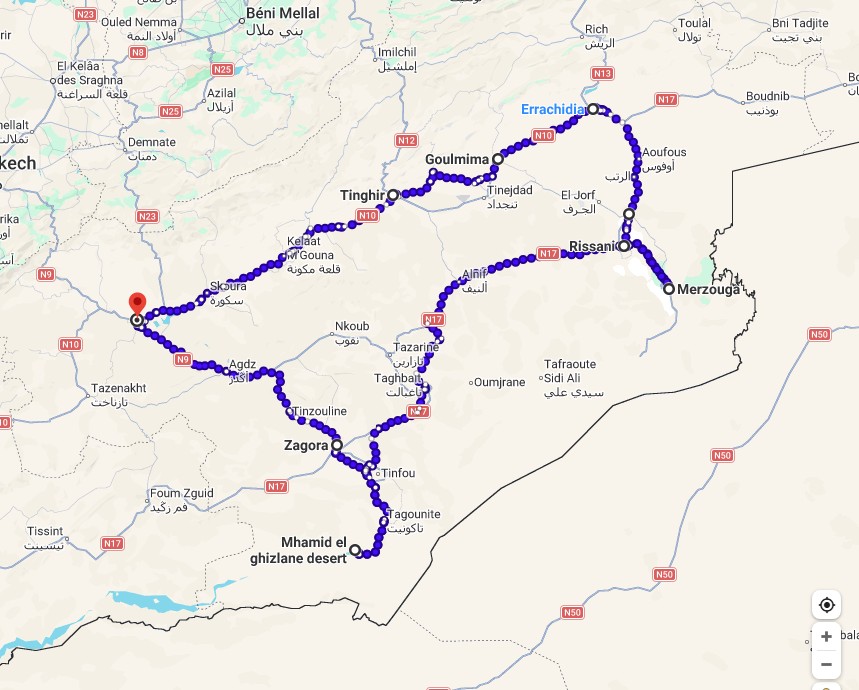
 This circuit is designed for travelers who wish to experience the true essence of Morocco’s desert provinces. By connecting volcanic ranges, verdant palm groves, and ancient fortified settlements, this route offers a deep dive into the region’s historical and environmental heritage.
The Itinerary: A Step-by-Step Guide
Ouarzazate (The Gateway):
See: The Taourirt Kasbah and the cinema museum.
Do: Visit the Atlas Film Studios to understand the region’s cinematic history.
Avoid: Express tours that overlook historical context.
Skoura (The Historic Oasis):
See: The Amridil Kasbah, a 17th-century architectural gem.
Do: Walk through the palm grove to discover traditional irrigation systems (khettaras).
Avoid: Motorized vehicles in the palm grove, which damage fragile soil.
Kelaa Mgouna (The Valley of Roses):
See: Rose fields in bloom (April/May).
Do: Visit local cooperatives to see traditional rose water distillation.
Avoid: Buying rose products on the roadside without verifying their artisan origin.
Boumalne Dadès (Rock Formations):
See: The “Monkey Fingers” rock formations.
Do: Drive to the panoramic viewpoint at the top of the road’s curves.
Avoid: Entering the gorges for complex hikes without a local guide.
Tinghir (The Strategic Hub):
See: The verdant palm grove and the Todra Gorge entrance.
Do: Hike through the oasis to understand local agro-ecology.
Avoid: Peak hours when tour buses create congestion.
Tinjdad & Goulmima (Preserved Authenticity):
See: The Oasis Museum (Ksar El Khorbat) in Tinjdad.
Do: Explore inhabited ksour and engage with residents.
Avoid: Taking photographs of residents without explicit consent.
Errachidia (The Crossroad):
See: The Hassan Eddakhil Dam and its panoramic mountain views.
Do: Explore local markets for regional products.
Avoid: Parking haphazardly along national roads.
Rissani (Dynastic Cradle):
See: The Moulay Ali Cherif Mausoleum and the grand souk.
Do: Visit on market day for an authentic experience.
Avoid: “Fake guides” pushing you toward specific shops.
Merzouga (Erg Chebbi Dunes):
See: Sunset and sunrise over the dunes.
Do: Walk on the dunes to experience the desert’s vastness.
Avoid: Quad or 4×4 rides directly on sensitive dunes to prevent irreversible erosion.
Mhamid & Zagora (The Draa Valley):
See: The Tamegroute Quranic Library.
Do: Explore the Draa Valley’s palm groves and earthen villages.
Avoid: Leaving any waste; the region is environmentally sensitive.
Sustainable Travel Tips
Water Conservation: Water is the most precious resource in the desert; please use it sparingly.
Economic Empowerment: Purchase crafts directly from local cooperatives to ensure your contribution benefits the creators.
Pacing: This loop covers significant distance. Embrace the slow rhythm of the oases—it is the only way to witness the beauty of this transition between mountains and sand.